
What You'll Learn
- How organic pest management differs from conventional IPM and where the rules get stricter
- The four-tiered intervention hierarchy and what you have to demonstrate before moving up each level
- What prevention actually looks like in practice, from building envelope management to storage layout
- Why any pest control substance needs certifier approval before you use it
- How to manage third-party pest control contractors so their work doesn’t put your certification at risk
Watch Time: 16:39
Transcript
Narrator (00:19):
As a manager of a food handling or processing operation, the principles of integrated pest management are already a part of your workflow. Preventing infestations, monitoring for pests, identifying thresholds, and applying targeted controls rather than relying on routine blanket chemical spraying. But what happens when you transition your facility to USDA certified organic? How do standard IPM strategies intersect with federal organic regulations? The good news is that organic pest control requirements share a lot of common ground with IPM principles. Both prioritize deep knowledge of pest behavior, diligent monitoring, and proactive prevention. Where organic pest management diverges heavily from traditional IPM is in the action threshold and targeted control phases. In conventional IPM, if prevention fails, you might quickly escalate to a synthetic chemical pesticide. In organic handling, you cannot simply jump to a chemical solution.
Narrator (01:25):
The regulations require you to follow a four-tiered hierarchy of interventions, and for any pesticidal substance, it must be listed in your OSP and reviewed by your certifier. At the most restrictive tier, synthetics not on the National List require explicit certifier approval on the substance, application method, and contamination prevention measures. Here, we’re going to go beyond the basics. We’ll take a deep dive into the specifics of this four-tiered approach and explore how medium-sized organic handlers implement these steps, how they manage the contamination risks of pest control applications, and how they navigate relationships with third-party pest control contractors.
Narrator (02:17):
But before we even reach the first tier of the organic pyramid, we must start with the prerequisite to all pest management. Monitoring. Your Organic System Plan must include a detailed description of your monitoring practices and procedures. You cannot prevent what you are not actively tracking.
Chad Olson (02:37):
So our pest control here is really awareness is number one, keeping doors closed, screening where you can. But mainly awareness, and that’s a big part of the roaster’s job, but it’s everyone’s job. Anyone when they pull pallets out from under a rack, it’s known you grab a broom, sweep it out, and look for pest activity.
Narrator (02:56):
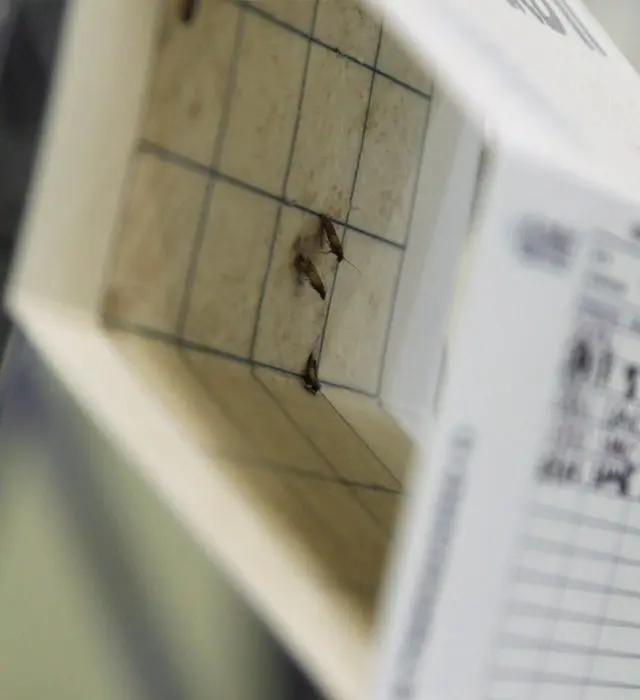
Monitoring acts as the eyes and ears of your facility. It involves regular documented walkthroughs to look for chewed packaging, droppings, or pest attractants like spilled ingredients or standing water. It also means checking your nonlethal catch traps and sticky boards to catch the very first arrivals before they breed. Because organic regulations significantly limit your chemical control options, early intervention through monitoring is your absolute best defense against an infestation.
Narrator (03:36):
If monitoring tells you what’s happening, Step A tells you how to stop it. Step A is the foundation of the organic pest management pyramid, prevention. The organic regulations require that handlers use management practices to actively prevent pests by managing environmental conditions and removing their habitat, eliminating their food sources, and denying them access.
Humberto Maldonado (04:01):
We don’t want to have pests in house that may cause food safety issues and that will require a chemical intervention that could jeopardize our organic certification or complicate it. So the best measure for pest control is always about prevention. You need to have a good monitoring system that is mostly traps, avoid places where pests can harbor. That’s why you get rid of the excessive weeds, unused materials. You also have to try to seal the spaces where pests can get into your facility.
Narrator (04:38):
Now let’s get into the specifics. Removing habitat means rethinking how you store your inventory. Rodents instinctively travel along the edges of a room, relying on their whiskers to navigate safely in the dark. Pulling your pallets and storage bins at least 12 inches away from the walls exposes that pest highway. This forces pests out into the open and gives your staff the physical space needed to place and monitor the traps. Preventing access means managing the building envelope. This includes fixing cracks in the foundation, installing door sweeps, and ensuring downspouts move water away from the building. For loading docks that must remain open during operation, handlers may utilize air curtains. These high velocity fans blow a continuous stream of air downward, creating an invisible barrier that flying insects cannot penetrate. Managing your facility’s environmental controls, keeping humidity low and air circulation high can effectively disrupt the breeding cycles of target pests.
Griffin Berger (05:46):
We used to have lots of issues with mice and with flying insects, and we got better doors on our facilities and we got better seals for the garage doors and we made a number of improvements, cleaned up the outside arounds of our building and we’re able to get rid of the pests and the flies. Having adequate airflow, that really helped, as well as having just the lights and the attractants and the sticky traps really, really makes a big difference.
Narrator (06:13):
One of the most effective strategies for preventing pest problems is managing environmental factors such as temperature, humidity, and air circulation. Certain humidity and temperature levels can create favorable environments for pests, but the levels desired vary by pest species. By using the results of your monitoring program, you can tailor the humidity and temperature to discourage the known pests for your area. Good air circulation can keep pests on the move, making it hard for them to congregate and breed within your facility. And finally, don’t allow standing water in your facility. Standing water is a haven for pest proliferation.
Narrator (07:03):
When prevention alone isn’t enough, you escalate to Step B, mechanical and physical controls. Because you must avoid contaminating the environment where organic food is handled, your indoor defenses will rely heavily on physical traps and deterrence. For rodents, handlers frequently use tin cats, which are nonlethal multi-catch traps placed along those 12-inch wall perimeters we discussed. These act as both monitoring devices as well as mechanical control traps. For insects, many use sticky glue boards and insect light traps, or ILTs. ILTs use ultraviolet light to attract flying pests to a specific location, trapping them on a glue board or killing them with an electric shock. Step B also includes the use of sound deterrence, like ultrasonic high-frequency devices or even recorded hawk calls to keep roosting birds away from your loading bays. Furthermore, this step allows for the use of repellents, such as essential oils or specific synthetic lures, like pheromone traps, to disrupt insect mating. These repellents and lures must be consistent with the requirements in the National List, but they are not considered pesticidal substances.
Narrator (08:31):
What happens if mechanical traps, physical barriers, lures, and repellents still fail to stop the pest pressure? You advance to Step C. This is the first time you may be permitted to use a pesticidal substance, but you are strictly limited to nonsynthetic materials or the very few synthetic materials explicitly allowed on the National List. Some common examples of Step C materials include using boric acid for structural insect control, but with the restriction that the boric acid does not come into direct contact with organic products, or placing diatomaceous earth inside ingredient storage areas to desiccate crawling insects. For exterior rodent control, handlers often utilize vitamin D3 bait.
Griffin Berger (09:20):
We do have some organic certified bait that they can feed on and then die, but it’s safe for birds of prey or dogs to eat the mice or rats, it won’t kill them. It’s an Agrid3 vitamin D3 isolate, so it’s a nutritional supplement if anybody else eats it, but rodents, they don’t need vitamin D3, so it pulls a calcium out of their cells and into their blood, but nutritional supplement for the dogs and the birds, so safe for everybody else.
Narrator (09:47):
The materials on the National List are selected because they carry a lower risk to the broader environment and to human health. However, here’s a critical compliance warning. Just because a material is on the National List does not mean you can go buy it and use it immediately. You must update your Organic System Plan and have your certifier review and approve the specific product, its source, and exactly where and how you intend to use it before you apply it.
Narrator (10:27):
If you face a severe infestation and Steps A, B, and C have proven ineffective, you reach the top of the pyramid, Step D. This allows the use of synthetic pesticides that are not on the National List. This is your absolute last resort. You can only use a Step D material after you have first demonstrated to your certifier that Steps A, B, and C were not effective. Your certifier must approve the specific substance, method of application, and measures to prevent contact with organic products or packaging before you use a Step D material. When your certifier reviews a Step D request, they are intensely evaluating the method of application, because the application method dictates the contamination risk.
Narrator (11:19):
For example, placing a synthetic rodenticide inside an anchored locked bait station on the exterior perimeter of your building poses a relatively low contamination risk. The poison is stationary and it’s far away from organic food. However, using a backpack sprayer for crack and crevice treatments inside your facility carries a much higher risk of drift, requiring strict protocols to protect nearby organic inventory. The highest risk application is fogging, which sprays a fine mist of pesticide throughout an entire enclosed volume. If fogging is deemed necessary and approved as your last resort, your intervention plan will be involved. All organic ingredients, finished products, and permeable packaging must be completely physically removed from the area prior to treatment. Afterward, the space and all shared equipment must be thoroughly cleaned and purged to remove any lingering chemical residue before a single organic product can be brought back inside.
Narrator (12:32):
Many facilities hire specialized third-party pest control contractors to help with the complexity that is pest management. This makes sense from an operational standpoint, but it introduces an organic compliance risk also. Under the organic regulations, your contractor is not responsible for your organic integrity. You are.
Kaylee Pickering (12:54):
We work with a third-party pest control company. We have to work alongside them to make sure any pest control solutions that they’re bringing into our facility or outside the facility fall into organic certification. So during the audit, the auditor or inspector will ask you for all of your pest control. They’ll ask you for a layout of your facility and a map of all of the pest control systems that you have.
Debbie Byrne (13:24):
We have to manage anything we do with organic, and that does include them. So we have to review anything they’re using. We have to review where they’re using it. We check out with them every time they leave. They have to let us know what they used, where they found rodents. So it is our responsibility to make sure they’re doing what they say they’re doing for us.
Narrator (13:45):
Your pest contractor must be trained to understand that they cannot use new chemicals or remedies simply because they find them to be effective, or even because they use them at another organic facility. Only your certifier can approve a material for use in your facility and under specific circumstances. If your contractor uses an unapproved Step D synthetic material inside your warehouse, even if you told them not to, your organic certification is on the line. As a facility manager, integrating organic regulations with your standard IPM strategy is an exercise in active, diligent defense. It requires meticulous recordkeeping, a deep understanding of your facility’s vulnerabilities, and total oversight of anyone operating within your walls. Every application of a pest control substance must be documented, approved by your certifier, and your Organic System Plan must be updated to reflect any new substance or method used. Those records are what your inspector will review and what protects your certification when tough pest control decisions are made.
Genevieve Albers (14:59):
At TM we have a big manufacturing facility with lots of doors and things that. So the potential for pests to get in is real. We make sure that anything we want to use in the factory, whether the pest management company suggests it or we ask them to implement it, it all runs through our certification specialist first to be added to our materials list. And the materials list is just one of those boxes that you check on your Organic System Plan.
Narrator (15:25):
By designing your facility to be organized, clean, structurally exclude pests, embrace mechanical monitoring, and adhere strictly to the organic pesticide hierarchy, you safeguard your inventory, protect your consumers, and uphold the global trust placed in the organic seal. In organic handling, when you master prevention, you rarely have to rely on the cure.
Transitioning a facility to certified organic changes how you handle pests, and this video walks through what that shift requires. It lays out the four-tier hierarchy of interventions the organic regulations impose, from prevention through physical controls, National List materials, and synthetic pesticides as a last resort, and explains why you can’t move up a tier without documenting the failure of the one below and getting your certifier’s approval first. Along the way, experienced handlers describe the prevention and monitoring practices they rely on day to day, how the method of application shapes contamination risk, and what changes when a third-party contractor is doing the work inside your facility. It’s a useful orientation whether you’re building a pest management program, reviewing the one you already have, or bringing a contractor into an organic operation.
About the Featured Operations
Raven’s Brew
- Coffee Roaster, Wholesale & Retail
- Tumwater, WA
- Certified Organic since 2002
A small family-owned coffee roaster producing organic and conventional blends, serving grocery stores, cafes, service organizations, and direct-to-consumer customers online. It grew customer by customer from a small operation into a roastery that emphasizes strong relationships with its importers and green-coffee suppliers.
Organically Grown Company
- Organic Produce Wholesaler & Distributor
- Portland, OR
- 260 Employees
- Certified Organic since 1998
An organic produce wholesaler and distributor sourcing certified organic fruits and vegetables domestically and internationally for retailers, restaurants, buying clubs, and processors. At its core a logistics operation, it also sorts, repacks, co-packs, and private-labels. Founded to support local organic growers, it is now purpose-trust owned, serving a mission rather than profit and committed to advancing organic.
Sauk Farm LLC
- Organic Fruit Grower, Packer, & Aggregator
- Concrete, WA
- Certified Organic since 2016
A family farm growing organic apples and plums and processing them into juice, dried fruit, and fruit powders. Its philosophy is to do the work in the field and let the fruit speak for itself, avoiding additives and preservatives. It also custom-processes and co-packs for other farms and food businesses, valuing the diversification that brings.
Sailer’s Food Market & Meat Processing
- Meat Processor & Butcher
- Elmwood, WI
- 28 Employees
- Certified Organic since 2016
A meat operation offering both slaughter and processing services for organic and conventional product. It handles animals from intake through cutting, cooking, and packaging, and also hauls livestock for customers who lack their own transport, caring for animals in its possession as they would be on the farm.
Cedar Grove Cheese
- Organic Cheese Maker
- Plain, WI
- 28 Employees
- Certified Organic since 1995
A family-owned cheese manufacturer producing both conventional and organic cheeses, including cow, sheep, and goat varieties. Small enough to design productions directly to a customer’s specifications, it makes specialty cheeses and produces in bulk for other companies to label and market.
Traditional Medicinals
- Organic Herbal Teas
- Rohnert Park, CA
- Certified Organic since 1995
An herbal tea company and early organic adopter, deeply committed to its source communities and organic teas. It sources organic botanicals from grower communities worldwide, treating those relationships as essential to its work, and advocates for organic on a broader scale beyond its own products.