
What You'll Learn
- Organic control points (OCPs) in the processing workflow, from active production to work-in-progress (WIP) stages.
- Contamination risks posed by hand tools, water additives, boiler chemicals, and packaging materials.
- When a purge is needed for shared equipment and what you have to document when you use one.
- Scheduling strategies that reduce human error when running both organic and conventional products.
Picture how ingredients flow through your facility during processing. What are points where contamination or commingling could happen? Think through everything that contacts, or could contact, organic ingredients and products as they move through different areas of your facility. These are the Organic Control Points (OCPs) that you must address when protecting organic integrity during processing.
Commingling with nonorganic ingredients and contact with prohibited substances can easily occur when handlers don’t think through and plan their process from a risk reduction perspective. Organic products can become commingled with nonorganic products during the processing of conventional items or the handling of allowed nonorganic ingredients, and they can come into contact with prohibited substances through packaging materials, storage containers, or substances used for cleaning, sanitizing, and pest control.
Work-In-Progress (WIP)
Some of the greatest risks to organic integrity emerge during work-in-progress (WIP) stages of production, when ingredients or products are temporarily stored, moved, or awaiting the next processing step. These transitional points create opportunities for organic and nonorganic products, or prohibited substances, to be accidentally mixed if materials aren’t clearly identified and kept separate. Making it a routine step to assess each WIP stage for potential commingling or contact with a prohibited substance, before it happens, is one of the most effective ways to protect organic integrity.1
Questions to ask when using a Work-in-Progress (WIP) system, to identify Organic Control Points:
- What equipment or hand tools are used to transfer products/ingredients?
- Are they dedicated organic?
- How are they cleaned?
- What are the WIP containers made of?
- Are they lined?
- Are the WIP containers dedicated organic?
- If the WIP containers are reused or shared between organic and nonorganic products, how are they effectively cleaned?
- Do the WIP containers have lids?
- Is there any risk of commingling or contamination if the top is open?
- How are WIP containers identified as organic? (See article Labeling Requirements for Nonretail Containers for detailed requirements.)
- Where are containers moved through and stored?
- What contamination risk exists from pest control or sanitation substances?
- What commingling risk exists from nonorganic processing?
To reduce this risk, facilities can implement visual identification systems for WIP storage. Intermediate holding bins, buckets, totes, and tanks should be clearly labeled at all times to indicate their current contents and those contents’ organic status. For example, green buckets can be used for organic WIP while white or red buckets are used for nonorganic WIP. High-contrast placards, magnetic signs, or other easily movable labels can allow floor staff to immediately identify whether a container holds organic or nonorganic product, reducing the likelihood of mistakes during production.
We have magnets that we put on the tanks so that [floor staff] know if [a tank of milk] is organic or conventional … Everything else we keep organic … so the only thing we’re going to cross-contaminate would be our milk. And by isolating it, labeling it correctly, knowing what you’re running, checking your computer, we can prevent cross-contamination.
Water
The USDA organic regulations specify that water used in processing meet the Safe Drinking Water Act (SDWA) standards.2 If water has direct contact with organic products in your process, your certifier may request an annual water test for harmful bacteria and possibly nitrates. Typically, testing will only be requested if the water is from nonmunicipal sources, such as a well or surface water.
If you use water as a rinse, your certifier will need to know what, if any, substances were added to the water that will have direct contact with organic products, and at what stage in processing that additive was used. Common water additives used in organic handling:
- Chlorine allowed concentrations vary by processing stage. If used in the final rinse water that contacts organic products, it must comply with the Safe Drinking Water Act (SDWA) concentrations.
- When cleaning produce, concentrations of up to 10 ppm are allowed, so long as it is followed by a final rinse.
- Water that makes final contact with produce must not contain more than 4 ppm of chlorine, in compliance with the Safe Drinking Water Act (SDWA).3
- The procedures used to wash produce and to monitor chlorine levels in the wash water must be included in your OSP, and your inspector may request records of the procedure.4
- Peracetic acid can be used in your process as wash and/or rinse water, according to FDA limitations, and as a sanitizer on food contact surfaces.5
- Hydrogen peroxide is also allowed for use on food contact surfaces with no restrictions required by the regulations.6
Hand Tools
Some processes will use hand tools, like scoops or knives. A common OCP for contamination is knives that are stored in a sanitizing solution when not in use. Most sanitizing solutions contain quaternary ammonium compounds, which leave a persistent residue and is considered a prohibited substance that cannot contact organic products. This means that any equipment must be rinsed in water after contact with a sanitizing solution that contains a prohibited substance and before contact with organic products.
Another common OCP for commingling is scoops. If the scoops are used for both organic and nonorganic ingredients, then commingling from particles on the scoops is a concern. Even when nonorganic ingredients are permitted in product formulations, their concentrations and uses are tightly controlled, and unintended contact is still commingling.
Boiler Chemicals
Steam is sometimes used in the processing of products, or in cleaning and sanitation. The boiler, which heats the water into steam, has boiler chemicals added to it to protect the mechanical parts, similar to how a car has oil added to the engine. Sometimes boiler carryover happens, where these boiler chemicals can get into the steam, resulting in a possible source of contamination.
Some steam systems are closed, meaning that the steam does not contact organic products. For example, in cheese factories, steam may be run through pipes to heat the ingredients, but the steam has no contact with the organic products, only the interior of the stainless steel pipes. If your process uses a closed system, then any boiler chemicals may be used.
If the steam contacts organic products or the interior of organic packaging, and contains volatilized chemicals from boiler additives, then these chemicals are considered processing aids.7 They then must be on the National List of Allowed and Prohibited Substances for them to be allowed for use. For example, frozen vegetables are often blanched with steam in batches before freezing. This steam must either be free of boiler chemicals, or the chemicals must be consistent with the National List.
Boiler chemicals allowed on the National List include:8
- ascorbic acid,
- citric acid,
- potassium carbonate,
- potassium hydroxide,
- sodium hydroxide, and
- sodium carbonate.
Your certifier will need documentation for any boiler chemicals in steam that contacts organic products. They will also ask how you assess or measure whether you have boiler chemicals in your steam that could contact organic products. They may require documentation that the boiler chemicals are nonvolatile and do not carry over into the steam. If boiler chemicals are volatile and could be present in steam that contacts organic products, then you need to document in your OSP how you prevent boiler chemicals from contacting organic products. For example, some handlers turn off the boiler chemical feed a specific number of hours prior to organic runs, and they also conduct tests on the steam for boiler chemicals.
Considerations for Equipment in Mixed-Use Facilities
If you have shared equipment, used for both organic and nonorganic handling, then equipment cleanout prior to organic processing is an especially important OCP for preventing commingling and contamination.9
Sometimes a purge is used to remove nonorganic ingredients or processing aids from inside equipment that cannot be otherwise physically cleaned. For example, to clean conventional corn from a mill before an organic run, you could send a small but sufficient amount of organic grain through as a purge to get out all of the conventional grain in the machine. When you do this, that organic grain used for purging is no longer organic, since in the purging process it became commingled with the previous run of conventional grain.
If you use the purge method, document:10
- The amount of organic material used in the purge,
- How you determined the amount was sufficient to remove nonorganic residue,
- Where or how you disposed of the purged material (for example: discarded or sold/used as nonorganic product).
Consider carefully the sanitation protocols you choose for this shared equipment. Are the same protocols used prior to both organic and nonorganic processing? It’s often preferable that they are the same, because this reduces the opportunities for human error. For very simple protocols you may be able to establish an SOP, and avoid documenting cleaning each time. For example, if you are a small operation that mixes dried herbs on a stainless steel counter, and before each run you wipe the counter down with vinegar followed by a water rinse as a standard operating procedure, your certifier may not require that you document each cleaning.
However, if you use a different sanitation protocol prior to organic processing than you use before your conventional runs, then the employees on-shift must be effectively trained to perform and document the organic protocol. Additionally, you’ll want to consider how you schedule these cleanings, because it may be time-consuming to do a full cleaning, and you may not want to switch between nonorganic and organic processing within a single day.
Packaging and Containers
Be careful that your packaging isn’t a source of contamination or commingling.9 Packaging and storage containers cannot contain synthetic fungicides, preservatives, fumigants, ethylene scavengers, antioxidants, or antimicrobials. Ensure that you are sourcing appropriate packaging materials and that they are not exposed to any contaminants in your facility, such as those sometimes introduced by fogging treatments.
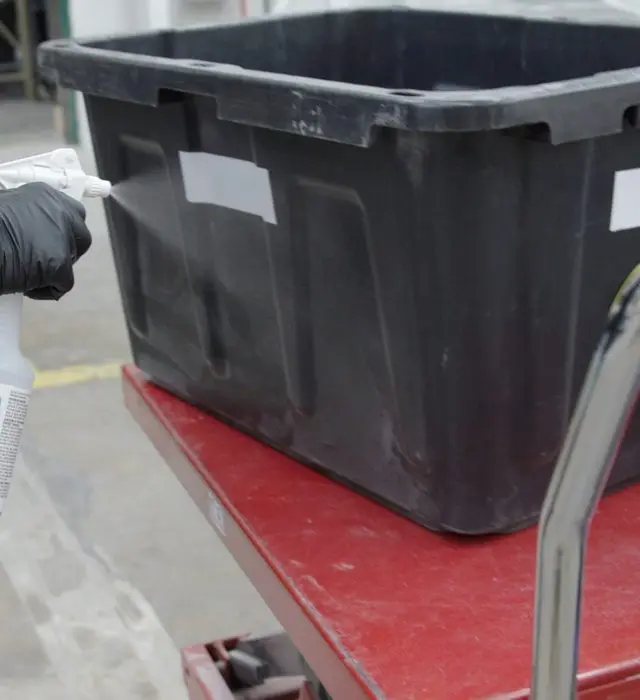
Most handlers will also have containers that are used during production, like totes, bins, carts, etc. These containers are often reused. Examples include proboxes (large plastic bins) at a grain mill that are used to store grain before and during the milling process or wooden drying trays for washed fruits and vegetables.
It is common for handlers to reuse a container that was previously used to store nonorganic product or prohibited substances, particularly in mixed-use facilities. For example, a split operation grain mill may use proboxes to store organic corn, and then later use them to hold conventional wheat. While this can be allowed, reusing containers also poses a risk for contamination.
The reuse of any bag or container is prohibited if it has been in contact with any substance that could compromise organic integrity. Reused containers are only permitted if the containers can be thoroughly cleaned so that the risk of cross-contamination is prevented.11 You may need to demonstrate to your certifier how the cleaning conducted is sufficient to prevent the contamination of organic product, e.g., by providing test results showing no detectable prohibited residues.
If containers are cleaned, the method and date of cleaning should be documented for verification at the annual inspection.
Porous vs. Nonporous Materials
Porous materials have a high cross-contamination risk because they trap chemical residues and microscopic contaminants deep within their fibers and are very hard to clean. Cardboard, paper, and untreated wood are all porous, and it’s very unlikely that your certifier would allow you to reuse them. Compostable, biodegradable, and “smart” packaging, such as PLA, is usually just as risky as paper-based containers. Their porous, biodegradable structure can absorb contaminants just like paper.
A common workaround to accommodate the reuse of porous containers is the use of disposable plastic liners (bags) that can be disposed of between loads. These liners function as a nonporous barrier, preventing contamination from the structural container.
Nonporous containers are what you should look for if you want to reuse containers between organic and nonorganic products without the use of disposable liners. Common nonporous materials include glass and stainless steel. These materials are the easiest to clean and have the lowest risk of cross-contamination. Plastic containers can also be reused, but only after a strict cleaning procedure. When nonporous containers are reused between nonorganic and organic products, they must be washed and sanitized according to written protocols prior to organic contact, and those actions must be documented.
Conclusion
Processing is where organic integrity is most vulnerable, not because the risks are unavoidable, but because there are so many of them, and they tend to hide in the details. A knife soaking in a prohibited sanitizer. A shared scoop. A WIP bin with no label on it. None of these feel significant in the moment, but any one of them can create a compliance problem. The path forward is the same in every case: assess your process step by step, identify where risk exists, and build a procedure that makes the safer path the default and reduces reliance on individual judgment in the moment. Approached this way, protecting organic integrity during processing becomes less about vigilance and more about a well-designed system.