
What You'll Learn
- The distinction between an audit trail and a traceback, and what each requires from your recordkeeping system
- How the three categories of audit trail records must connect through shared identifiers to form a traceable chain
- How lot numbers transition from supplier lot to internal lot to finished product lot, and what to document at each handoff
- The organic labeling and unique identifier requirements for nonretail containers under 7 CFR §205.307
- The most common audit trail failure points, with real examples and fixes
- How to run an internal traceback audit to find and correct gaps before an inspector does
An organic audit trail is not simply a binder, software module, or single document. It is the system of linked documents that, taken together, tell the complete story of how organic product was received, handled, and shipped, including points in the supply chain where you may not physically take possession but still own the product at the time (for example, a contracted Third Party Logistics (3PL) or warehouse). The regulatory goal is that an inspector, at any time, announced or unannounced, can walk into your operation and follow the documents from your finished product (or sale) back to a certified organic source.
The regulatory requirements for what records you must keep and principles for designing a system that produces those records are covered in other articles. This article focuses on the chain itself: how documents link, how lot numbers transition through production, what the regulations require for nonretail containers, and how to test and maintain the trail over time.
The Audit Trail and the Traceback
Two terms describe the same records from different angles:
- The audit trail is the system: the connected set of records that exists in your facility at all times, built record by record as product moves through your operation.
- A traceback is what you or an inspector do with that system: select a finished product lot (or sale) and follow the chain of linked documents backward, all the way to the last certified organic operation in your supply chain.1
A traceback only works if the audit trail supports it. If the chain of documents links together without gaps from an outgoing invoice to your customer through batch records and receiving a log to a supplier certificate, the traceback succeeds.3 If any link is missing or breaks, it fails at that point.
[A] traceback is the demonstration of taking a finished product and going all the way back to the source for everything in it. We can do that because we have lot-coded finished product and that lot code corresponds to a master batch record, [which] corresponds to a date and a time. We can pull up those files and see which materials, with which batch numbers, associated with which supplier, associated with which farm or collection. That’s the origin. It’s going from the shelf all the way back to the farm.
Shared Identifiers in the Audit Trail
Document Categories of a Complete Audit Trail
A complete audit trail at a handling operation generally consists of three categories of records: incoming, internal, and outgoing. The categories themselves matter less than the requirement that they connect. A broker or importer may only have two categories because there is likely no internal handling occurring. Every category applicable to your operation must be present in your audit trail documentation, and every document within a category must share at least one identifier with a document in an adjacent category. When all three categories are linked through shared identifiers, complete traceability is achieved. When a category is missing or the link between categories breaks, the traceback fails.
1. Incoming Records
Incoming records answer two questions: where did this product come from, and was that source certified? Every organic receiving event should generate a set of documents that, as a set, establish organic status.3,4 The receiving records you will need may vary depending on your specific business.
The core incoming documents may include:
- Supplier’s Organic Certificate: Verify using the Organic Integrity Database (OID) that the supplier is currently certified and that the certificate scope covers the specific product you are purchasing. A certificate that doesn’t name the product you’re buying doesn’t establish organic status for that product.
- Invoice or Purchase Order: Must explicitly designate the product’s organic status: “100% organic,” “organic,” or “made with organic.” Stating only the ingredient, like “oats,” is not sufficient to demonstrate organic status. There must be a specific identifier, such as “organic,” “O,” or other abbreviation. An invoice that doesn’t indicate organic status fails the audit trail test regardless of what certificate is on file. This document should include the shipping lot number.
- Bill of Lading or Shipping Manifest: Documents the shipment from origin to the next destination. Must indicate the specific product being shipped and its organic status. A unique identifier must link these documents to others in the audit trail.
- Receiving Log: Your internal record confirming receipt, recording the supplier name, product designated as organic, quantity, date, and the lot number you assign. This document bridges incoming records to internal records by recording both the supplier’s lot number and your internally assigned lot in the same entry. For operations contracting third-party warehouses, this should be provided by the third-party warehouse.
- Certificate of Analysis (COA): The product specification sheet for the specific lot received. Useful for lot-level traceability and for verifying that the received product matches what was ordered.
- Clean Truck Affidavit: For bulk product, documents that the transport vessel was free of prohibited substances before loading. All transportation needs to be verified as free from contact with prohibited substances and commingling with nonorganic product.
- NOP Import Certificate: An electronic document used only for organic products being imported into the U.S.. It is generated by the exporter’s certifying agent in the Organic Integrity Database. It provides traceable proof that a shipment was verified by a certifier as organic.
When we receive the product, we look at the invoices and make sure they say organic. We look at the actual product to make sure the lot codes match what the invoice says and what the COA says. Then we put it on the receiving log and we automatically link the certificate of analysis and the invoice to that receiving log online.
2. Internal Records
Internal records answer the question: what happened to this organic product inside your facility or once you assume ownership? They are the connection between what you received and what you shipped.
The central internal document is the batch or production record. It should record which ingredient lot numbers were used (the link back to incoming records), quantities of each, the date, and the finished product lot number assigned to the output (the link forward to outgoing records). In any multi-ingredient operation, the batch record is the document that connects every ingredient source to every finished product lot. Without it, the middle of the audit trail is missing.
Other supporting internal records can include work orders, blend sheets, storage logs, cleaning records, and pest management logs. Records for your operation will be specific to your operation2 and fully disclose what happened to organic product during handling.3 You must have records that enable your certifier to audit them and that demonstrate your compliance with the USDA organic regulations.4,6
It is important to note that internal records may not apply to you if you never take ownership or physical possession of the product, such as an operation brokering a sale in which the product ships directly from seller to buyer. Receiving and inventory records for third-party warehouses are key records in this case.
3. Outgoing Records
Outgoing records document who received this organic product, when, and in what quantity. Sales invoices, bills of lading, packing slips, or any other sales documentation you maintain must designate the product as organic and enable traceability back through your production and supply chain to the last certified handler before you.3 The lot number (or other unique ID) on outgoing documents is what links a specific customer shipment back through the batch record to every ingredient lot that went into it. Some records may be issued by other third-parties (contracted warehouse) and will need to be collected.
Every single shipment that we receive, every single product that we sell has a BOL and a packing list. That’s where we list the lot code. That’s where we list the description of the product, that it is organic.
Three-Category Organic Audit Trail Example
| Document | Key Information It Captures | Identifier That Links to Adjacent Document |
|---|---|---|
|
1. Receiving Log |
|
Supplier Lot Number and PO Number |
|
2. Batch Record |
|
Supplier Organic Lot Number Finished Product Organic Lot Number |
|
3. Sales Invoice |
|
Finished Product Organic Lot Number (Links back to the Batch Record for traceback during audits) |
|
Every document in each category shares at least one identifier with a document in an adjacent category. This is what makes the trail traceable. |
||
Unique Identifiers and Lot Numbers
A unique identifier is generally a set of numbers, letters, or symbols assigned to a specific product that creates an auditable record between documents. Examples include lot numbers, purchase order numbers, bill of lading numbers, work order numbers, batch numbers, production dates, and bin numbers.
The basic requirement is simple: each document must contain at least one identifier that also appears in at least one adjacent document to create the link between the two. The simpler the system, the easier it is to make the connection. Using the same identifier throughout the system creates the clearest traceability. What unique identifier you may use will depend on the type of activities conducted by your operation and the type of products handled by your operation.
Lot numbers are the most reliable identifier in the audit trail because your operation assigns them, controls their format, carries them forward through every stage, and can print them on physical containers. A lot number gives a specific quantity of product a unique, persistent identity that follows it through every record.7
Building Effective Lot Numbers
A lot number doesn’t need to be complex, but it needs to be unique, consistent, and informative enough for someone unfamiliar with your system to understand what it references. An inspector visiting for the first time, or a QA manager taking over from a predecessor, should be able to look at a key and then read your lot numbers and know what they represent without asking anyone.
Most effective lot number formats encode at least one of these elements:
- Date (so you can quickly identify when a lot was created or received);
- Product or ingredient code (so you can identify what the lot contains);
- Sequence number (so multiple lots created on the same day for the same product are distinguishable).
A date-based format like YYYYMMDD-001 works for many operations. A product-code-and-sequence format works for others. The specific format matters less than using it the same way every time.
How Lot Numbers Transition Through the Production Chain
The most common gap in an organic audit trail is an undocumented lot number transition. As product moves from receiving through production to shipping, lot numbers can change at each processing point. Each transition must be documented so the chain remains traceable. If a lot number changes without a bridging record showing both the old and new identifier, an inspector cannot follow the chain through that point.
The transition happens generally in three stages, though your specific processes may vary:
- Stage 1 — At receiving: the ingredient arrives with the supplier’s lot number. Your receiving log records that supplier lot number alongside the internal lot number you assign. Both identifiers appear in the same document. That receiving log is the bridging document. An inspector can look at the incoming supplier invoice (which carries the supplier lot) and the receiving log (which carries both the supplier lot and your internal lot) and follow the chain forward into your system.
- Stage 2 — In production: your internal ingredient lot number enters the batch record. When multiple ingredients combine into a finished product, the batch record lists all input lot numbers and assigns a new finished product lot number to the output. The batch record is the only document where all of those lot numbers appear together, so it must be complete. A batch record that lists the ingredient names but not their lot numbers cannot support a traceback.
- Stage 3 — At shipping: the finished product lot number appears on the nonretail container label, the packing slip, the bill of lading, and the sales invoice. Any of those documents links a customer shipment back through the batch record to every ingredient lot that contributed to it.
The way that lot numbers change throughout the entire system is oftentimes not really well defined on paper. It’s something that’s really clear to the QA manager … but not obvious to the inspector who is usually looking at these documents just once. Showing how it’s really obvious that an inbound lot number changes to a work-in-progress lot number changes to a finished goods lot number, … you want to make that really obvious so that the … inspector can make the connections.
Lot Number Transition Example
Nonretail Containers
A nonretail container is “any container used for shipping or storing organic product that is not used in the retail display or sale of the product.”7 Produce boxes, bulk bags, totes, bins, master corrugated cases, bulk tanks, trailers, and grain railcars are all nonretail containers. These are the physical objects that move organic product through the supply chain.
The USDA organic regulations impose specific labeling requirements on nonretail containers, and those requirements extend into the audit trail itself. Every nonretail container must display two things:8
- Organic identification: the word “organic,” an abbreviation such as “OG,” an acronym, or the USDA organic seal. Temporary signs or labels are permitted for containers where permanent marking is impractical due to size, shape, or material.
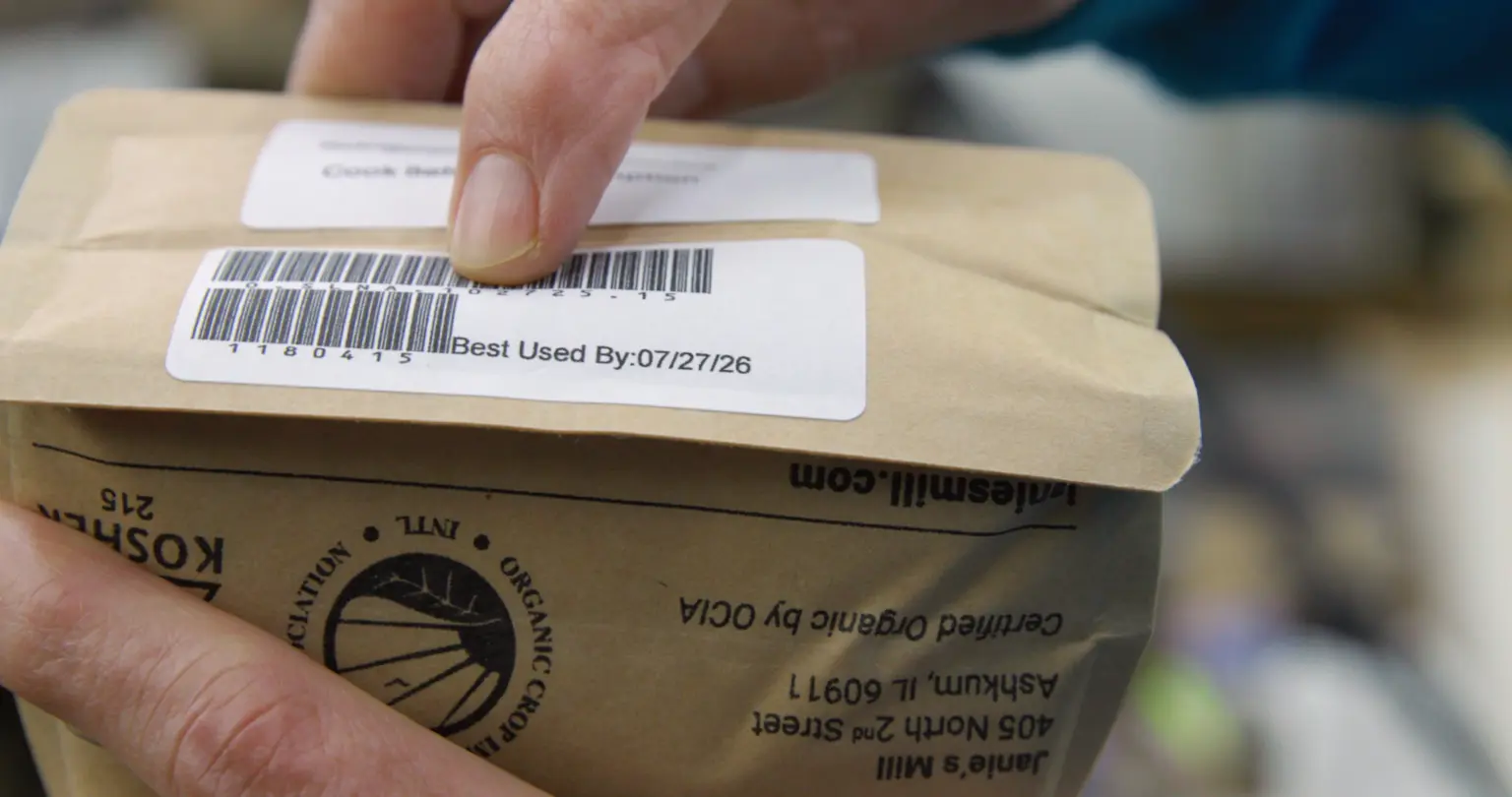
- A unique identifier: a production lot number, shipping identification, or other information that links the physical container to its audit trail documentation.
The audit trail documentation associated with a nonretail container must identify the last certified operation that handled the product.9
One narrow exception applies. When a nonretail container ships or stores products already packaged for retail sale, and the organic identification is visible on the retail label, the container itself does not need to identify the product as organic.10 It must still display the production lot number, shipping identification, or other unique information that links it to audit trail documentation.8
Why is this labeling important? The nonretail container label is the physical manifestation of the audit trail. When the lot number printed on a bulk tote matches the lot number on the bill of lading, which matches the lot number on the receiving log, the chain is intact all the way to the physical product. An unlabeled or improperly labeled container is a gap in the audit trail made visible at the receiving dock.
Anatomy of a Compliant Nonretail Container Label
Common Failure Points in an Audit Trail
Broken Links Between Document Categories
A traceback fails when an inspector cannot connect documents through a shared identifier. The incoming records are clean; the outgoing records are clean, but there is no document connecting them through the production step. Or the lot numbers are in every document, but they change at a processing point without a bridging record showing both the old and new identifier.
The most common version of this failure: an operation assigns an internal lot number at receiving but does not record the supplier’s lot number in the same document. The chain breaks immediately at the receiving log because the inspector cannot connect the incoming invoice to anything inside the facility.
The lesson from this example applies beyond fluid milk: even at a 100% organic operation, “all of it is organic” is not a substitute for documented traceability. The audit trail requires source-specific links between documents, traceable to a specific certified origin.4
Invoices That Don’t Say “Organic”
The invoice or bill of lading accompanying a delivery must explicitly identify the product as organic. A valid certificate on file does not compensate for a shipping document that just says “Oats.”4 Receiving staff should be trained to flag nonorganic designations on incoming paperwork before the product is accepted, not after.
Name Mismatches Between Documents
If the bill of lading says “Bob’s Farm” but the organic certificate on file says “Smith Agricultural LLC,” the link is broken. The inspector cannot confirm the shipment came from the certified operation without additional documentation bridging the two names.3,4 DBAs, trade names, and parent company structures all create this problem. Resolve it at the time of the first purchase, not during an inspection.
Missing Production Records
A handler has complete incoming records and complete outgoing records, but no batch record documenting what happened in between. When the inspector cannot establish how the received ingredient became the shipped finished product, the traceback fails at the internal stage.
For example, a sauce producer receives organic tomatoes. The receiving log, supplier invoice, and organic certificate are all complete. They make sauce and ship it with a correct sales invoice and bill of lading. But no batch record exists documenting that those specific tomato lots went into that specific batch of sauce. The audit trail breaks in the middle. The incoming records prove the tomatoes were organic. The outgoing records prove organic sauce was shipped. Nothing in between connects the two.
Testing Your System
The most practical way to find gaps before an inspector does is to run a traceback yourself: pick a finished product lot and follow the chain backward, noting every point where you have to guess, ask someone, or cannot see the link between two documents. Those points are your gaps.
The internal traceback also surfaces identifiers that have broken down over time. Lot number formats drift. Staff fill out forms differently. A field that once captured both the supplier lot and the internal lot starts capturing only one. Running a traceback regularly means you catch those drifts while they can be corrected, not while an inspector is sitting across the table.
Maintaining the Audit Trail Over Time
The audit trail is built in real time, not prepared before inspection. Records must document activities as they occur. Guidance and training materials published by the NOP note that records appearing to have been created after the fact rather than at the time of the activity can be a noncompliance indicator.1 A receiving log entry made a week after the delivery, or a batch record filled in from memory at the end of the month, creates the same kind of credibility problem as a missing record.
The practical discipline is simple: the receiving log is at the receiving dock and gets filled in when product arrives. The batch record is on the production floor and gets completed during or immediately after the run. Outgoing documents are generated at the time of the shipment. When documentation follows activity in real time, the audit trail builds itself. When it doesn’t, it has to be reconstructed, and that reconstruction is never as reliable as the original.
Operations that work through their first few inspections and address the gaps they find generally reach a stable state. The system runs on its own because the habits are in place.
Taking the feedback from the inspection process seriously and implementing changes that address the concerns raised … [most handlers] go through maybe one or two inspections before they are just free sailing … Once you’ve got your system down, it should run on autopilot.
Conclusion
An audit trail that works is one where every document in every category is connected to the next through identifiers that any inspector, on any day, can follow without asking anyone how the system works. Building that chain requires understanding incoming, internal, and outgoing documents, documenting lot numbers consistently through every transition, labeling nonretail containers correctly, and confirming through regular internal tracebacks that the connections hold.