What You'll Learn
- How an organic grain farm grew into a stone mill doing millions in sales
- How box-level lot codes let you trace a retail bag back to the farm lot
- What to confirm before buying grain, from organic certificates to security seals
- What a full traceback looks like – from finished package, back through milling, to source
- How moving from paper to an ERP system can reduce error and tighten traceability
Watch Time: 11:32
Transcript
Harold Wilken (00:12):
I don’t know very many organic farmers that didn’t come to it because of something they felt. It all started; I was a conventional farmer and about 10 years into my farming career, I did not like what we were doing to our soils. And I thought, you know, there’s got to be a better way to farm. In 2005, all the stars aligned, and I took the whole 700 acres organic. And I’ve never looked back. I was shipping wheat for chicken feed. I thought, why are we not feeding people? So then it was looking at, okay, how can we do this? Then 2013, I got a call from a guy. He had a new customer that had moved to Chicago, and he was looking for an organic farmer to build a mill. And I thought we could do this. I knew that I couldn’t manage this thing, and Jill had that commitment to organic, and so I said, “How would you like to be part of a flour mill?”
Jill Brockman-Cummings (01:34):
I’m Jill Brockman-Cummings and I am the mill manager at Janie’s Mill. I was the only employee for a good year and a half. I started working just trying to figure out, like, how do you become certified organic? Like, what do I need as far as documentation for this food that we’re going to be selling? Harold told me the farm certified organic through OCIA. Here’s a contact person. And I think I just called them up and said, “Hey, we’re going to start this stone mill. What is the process? What do I need to do?” There’s two people in the beginning at OCIA who I worked with, and both of them would answer my questions all the time. I mean, I could call them. I can email them. I always had really, really good communication.
Harold Wilken (02:21):
We started out almost all wholesale. And then when the pandemic hit in March, the retail then took over. We were getting orders 25 a day, then 50 a day. Went up to 200 a day. The BBC interviewed me. And at the same time, some magazine out in New York put out something about in the Midwest, Janie’s Mill has flour. 568 orders in one day. That put us on the map. People then found out about us. And then the wholesale came back and now we’re three-plus million dollars in sales.
Jill Brockman-Cummings (03:12):
We’re in the cold grain storage room. In here we have primarily these Pro Boxes, which hold about 2,800 pounds. Each row of ProBoxes is a different variety of grain. We make sure we have the organic label on there as well as the type of grain, in this case, Warthog Wheat, the farm lot number, which is the one that begins with NB1, and then the net weight. When we receive it here, we apply a letter and a number to make sure that each box has a separate lot code so that when we go to mill it, those codes will be carried through the whole system from milling to re-bagging to sale. Prior to even purchasing any grain, we make sure we have the current organic certificate on hand, and if it is a farm that we’re bringing grain in from that is not Janie’s farm, we require the security seals on the hopper truck or on the totes. I pulled up receiving grain from 2025. This was the BOL and paperwork we got on Certified Organic Durum that comes from Hutchinson Farm.
Jill Brockman-Cummings (04:36):
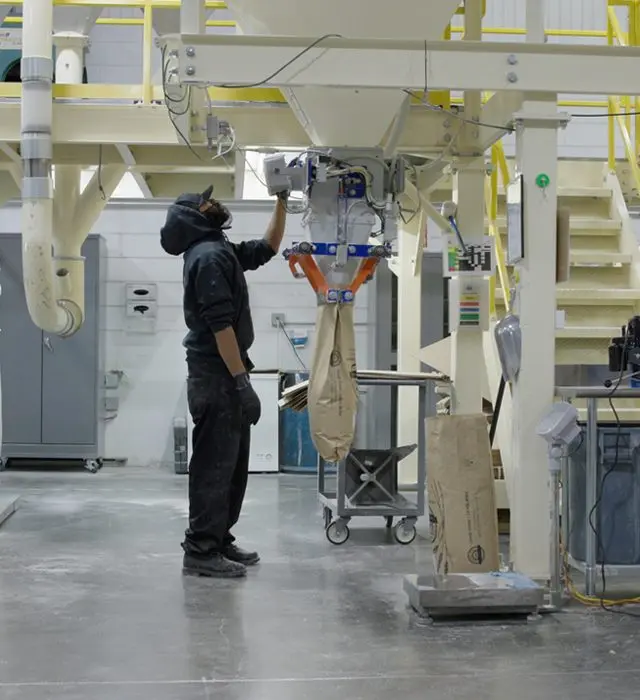
Okay, so then we’re going to go in here. At the point of production, the millers will grab how many boxes are going to be in that mill lot. They weigh them, and they record the box lots. The only thing we mill are certified organic grain, so super easy. It’s milling, getting sifted, the bran’s coming out. We also have to keep track of the organic brand. So we put on that tote organic bran, the date that we started, then we’ll put the ending date and that gets recorded in our system as well. This is the retail production area. So what they’re filling right now is Artisan Blend in 1.5-pound bags. The most important thing here is to make sure that the lot on that 50-pound bag matches the lot that they’re putting on the bottom.
Jill Brockman-Cummings (05:32):
We have end-of-shift cleaning protocols for every department, every area. This is called the cleaning between batches log or form. We also do cleaning between batches, whether it’s for food safety, like allergen controls, going from an allergen to a non-allergen. So like going from wheat to rye or wheat to corn, we have to document all that.
Jill Brockman-Cummings (06:00):
Before we had QuickBooks for this and we had a spreadsheet for that and I had binders for this. Everything was documented on paper. It was very time-consuming, very labor-intensive. There’s always human error. So now it’s all in one system. Everything’s going on our ERP software, and it allows us to track everything much more precisely.
Jill Brockman-Cummings (06:31):
It depends on the inspector, but generally they want to do a walkthrough first. And as I show them around, I might point out block codes, or I might point out where we store the grain, or where we store our finished product. They’re always interested in looking at labeling as I walk through with them. They always have an eye out for something that they might question. So we always try to make sure our facility is very nice and clean. From the visual just walkthrough inspection, then we usually go into the office, and they just start asking questions. They just kind of go through the notebook with me, so they want to know what are our products? Do we have any new products this year? Who are our suppliers? Then they’ll go into pest management. What does our pest management system look like? Then they’ll go into what does our sanitation and cleaning look like?
Jill Brockman-Cummings (07:24):
So they do like most of the general stuff first. Then they’ll start to delve into traceability. What we have here is a retail size package of semolina flour that we’re going to trace back to the actual milling. They re-bagged the organic semolina 10/27/25, which matches this. They took four 25-pound bags and they made 32 1.5-size bags. We milled it on 10/27/25. Bree, the head miller, entered this. It was milled on mill one. It’s organic Alzada Hard Amber Durum. This is the farm lot DH45B2. What we’re looking at here is when the durum arrived here at Janie’s Mill. What kind of grain is it and what’s the farm lot? And then we applied all of these lot letters and numbers.
Jill Brockman-Cummings (08:19):
I learned so much after that first inspection. You don’t know what to expect. I mean, you fill out the papers that they tell you to fill out. You make sure that you’ve been documenting. Every year I think I built confidence going into it, learned more. And I have to say, you know, the inspectors are not scary people. They’re very nice. If you ever wonder if you should write something down, write it down. I’ve learned over the years that yes, the more that you can document and prove, the better off you are.
Jill Brockman-Cummings (08:49):
Make sure that you’re sourcing from organic. Make sure that anything that you do is approved by your organic certifier. So that could be pest control. Same with sanitation. Are you going to clean with something? You got to make sure that that’s something that organic certifier says is approved. And every single product you create in every single size has to be approved by your organic certifier. I say organic is always, always worth it for your health, for the health of the planet. We charge more for our products because they are certified organic. But I think when the consumer understands the value that stone milling and organic brings to them, it’s always worth it.
Harold Wilken (09:40):
I’m amazed when I hear these people talking about, “Well, organic can’t feed the world,” because I think we’re living proof we can make a good stab at it. I’m 65 years old going on 66. This thing’s going to go on without me and it’s going to continue to take care of people. What we’re doing for the community. I mean, there are 32 jobs here, eight at the farm. So, 40 people in this community are benefiting from what we’re doing. I wouldn’t consider doing this as a conventional. No, I’m here for the health of the soil. I’m here for the health of the people and our health.
This video profiles Janie’s Mill, an organic stone mill in Illinois that grew out of Harold Wilken’s organic grain farm. Wilken converted his 700 acres to organic in 2005 after growing disillusioned with what conventional farming was doing to his soil, and when a chance came in 2013 to build a mill, he brought in Jill Brockman-Cummings to run it because she shared his commitment to organic. The mill scaled up dramatically when the pandemic shifted the customers from mostly wholesale to a flood of retail orders, hitting 568 orders in a single day after national press coverage. They now do more than three million dollars in sales. The story is a strong example of building an organic grain handling operation from the ground up.
Organic compliance is rooted in traceability, from receiving all the way to the retail bag. Incoming grain arrives in hopper trucks or totes and is transferred to labeled Pro Boxes marked with the grain type, farm lot number, and net weight. Then each Pro box gets its own lot code that carries through milling, re-bagging, and sale. Before buying any grain, the mill confirms a current organic certificate is on hand, and grain from outside farms must arrive with security seals on the truck or totes. Because everything they mill is certified organic, the process stays simple, but the discipline is in the documentation. Millers record box lots at production, track the organic bran separately, and match the lot on each finished bag to its source. Brockman-Cummings demonstrates a full traceback on a bag of semolina flour, following it from the retail package back through the milling date and mill number to the specific farm lot of durum wheat. The operation has moved off paper binders and spreadsheets into a single ERP system, which tracks everything more precisely and cuts the human error that came with the old approach.
The video also walks through what an inspection looks like. Inspections start with a walkthrough where the inspector notes labeling, storage, and cleanliness, then moves to the office for questions about products, suppliers, pest management, and sanitation before delving into traceability. Brockman-Cummings reassures viewers that inspectors are not scary, that confidence builds year over year, and that the guiding rule is simple: if you ever wonder whether to write something down, write it down. Her practical advice covers sourcing only organic grain, getting every material and every label approved by the certifier, and understanding that organic commands a higher price the consumer will pay once they see the value. For Wilken, the health of the soil and people is paramount and the mill is proof that organic can feed people and sustain a community, with 40 jobs now tied to the farm and mill.
About the Featured Operation
- Organic Stone-milled Flour
- Ashkum, IL
- 28 Employees
- Certified Organic since 2017
A stone mill producing flours from grain grown on partner farms and its own fields, with quality as its first priority. It sells wholesale to bakeries and retail to home bakers. The operation grew from a farming family’s interest in connecting good growers, careful milling, and bakers who value the resulting product.