
What You'll Learn
- Specific challenges faced by operations that handle both organic and nonorganic products.
- The role scheduling can play in reducing the risk of mix-ups.
- What equipment can be shared between organic and nonorganic runs.
- Helpful segregation strategies from other mixed-used organic handlers.
All organic handlers must maintain segregation and prevent commingling and cross-contact between organic and nonorganic product throughout the product flow, and must ensure organic product is not exposed to prohibited substances. Contact with prohibited substances, or commingling with nonorganic product at any point in the flow, can result in loss of organic status for the affected lot.
This article addresses split operations (facilities handling both organic and nonorganic product lines) where the risk of cross-contact and commingling makes rigorous segregation protocols, audit-ready recordkeeping, and employee training especially critical.
By implementing segregation controls at every point in the product flow such as receiving, storage, staging, processing, packaging, and shipping, handlers can preserve organic integrity, maintain certifier compliance, and protect the credibility of the organic label. Any point in the flow that presents commingling or cross-contact risk is a control point requiring documented procedures and ongoing monitoring. The regulations don’t prescribe a specific method for achieving this; it’s the handler’s responsibility to conduct a risk assessment of their own flow, identify these control points, and implement practices suited to their operation.
The following sections walk through the stages of a typical product flow and outline practical segregation measures a split operation can apply at each one.
Processing activities and receiving of bulk organic products often present some of the highest risks to organic integrity in mixed-use facilities, because organic products often move through equipment and work areas also used to make nonorganic products. Without appropriate controls, organic products can be accidentally mixed with nonorganic products or exposed to prohibited substances.
Equipment & Food Contact Surfaces
If you run organic and nonorganic product on the same equipment or food contact surfaces, a proper changeover clean before organic production is your primary control for preventing commingling.1 The right cleaning method depends on the equipment type, how it’s used, and how it’s designed to be cleaned.
Wet Cleaning
Equipment and food contact surfaces that are nonporous and able to be effectively cleaned with water can typically be washed with approved cleaning agents and sanitized with approved sanitizers to remove residues from previous production runs. Because these nonporous surfaces do not absorb materials, they are more suitable for effective cleaning and sanitation between uses, helping reduce the risk of cross-contact or residue carryover. Examples of equipment that can most likely be protected through cleaning and sanitation include:
- Stainless steel processing tables, racks, and carts
- Mixing tanks and kettles
- Conveyor belts designed for wet cleaning
- Plastic totes, bins, buckets, and containers
- Filling machines and nozzles (where manufacturer-approved)
- Pumps and piping systems used for liquid products
- Pasteurizers
- Packaging equipment designed for washdown
- Plastic, glass, or metal utensils such as scoops, paddles, and measuring tools
- Weighing scales with washable surfaces
Dry Cleaning
Other equipment, such as grain augers, flour mills, and coffee grinders, cannot be cleaned with water and instead require dry-cleaning methods.1 For some shared dry-processing equipment, handlers may use a “purge” to remove remaining nonorganic product. A purge involves running a calculated amount of organic product through the equipment to flush out residues trapped within the machinery.1 A purge quantity cannot be considered validated unless it is followed by a contact surface test confirming that only a de minimis amount of the previous product or ingredient remains. During the certification process, you would propose the purge quantity for your certifier’s approval, supported by this validation testing. The purged product itself may not be sold as organic; if it is sold, it must be sold as nonorganic. For this reason, some facilities may opt to run organic production on dedicated dry-cleaning equipment.
Purge Cleaning Method
Uncleanable Materials
Unlike glass, plastic, and metal, porous materials like cardboard, paper, and untreated wood present a high cross-contamination risk because they trap chemical residues and microscopic contaminants deep within their fibers. Therefore, porous equipment and food contact surfaces should never be used for organic storage or processing if they have been previously used for nonorganic storage or processing, unless a nonporous liner, like a plastic bag, is used to create a boundary between the organic product and container material. Examples of porous equipment or food contact surfaces that must be dedicated to organic use include:
- Wooden cutting boards or worktables
- Unfinished wood bins or crates
- Burlap or jute sacks used for storage or transport
- Canvas collection bags
- Felt filters or filter pads
- Natural fiber brushes or brooms used in direct product contact
- Uncoated cork components
- Stone millstones, depending on their condition and use
While some handlers commonly use containers for both organic and nonorganic products in storage and production, reused containers are only permitted if they can be thoroughly cleaned to remove residue of the prior product and protect against contact with prohibited substances.2 For example, grain processors may want to reuse bulk pro-boxes that previously held nonorganic grain for storing organic grain. Whether reuse is permitted depends on the container’s construction and surface — smooth, nonporous, and easily sanitized materials such as certain food-grade plastics or stainless steel are generally better suited to effective cleaning and reuse, while porous or seamed materials, such as untreated wood, cardboard, and woven or burlap sacks, are generally not suitable for reuse because they can trap residues. Handlers should assess each container type against these cleaning and residue standards and contact their certifying agent before reusing containers.
Dedicated Organic Equipment
Given that some equipment and tools are more easily cleaned than others, it can be advantageous to dedicate certain pieces to organic. Consider the risk of contamination from each machine. If most of your equipment is mixed-use, and you identify one particular machine that creates a high-risk for commingling or contamination (maybe it is difficult to clean), you might prioritize dedicating this particular machine to organic processing only. For example, a coffee processor uses shared roasting equipment, but because of a higher contamination risk in the grinding process, has invested in a dedicated grinder for organic batches.
Systems to Prevent Commingling and Contamination
Protecting organic products from contact with prohibited substances and keeping them separate from nonorganic products requires more than written procedures. It depends on systems that are easy for employees to follow every day and training that clearly communicates their responsibilities. Let’s look at two practices that mixed-use facilities often cite as key to preventing the mixing of organic and nonorganic products.
Time Segregation
A common best practice for preventing commingling in mixed-use facilities is to use time as a physical control buffer between organic and nonorganic production runs.1 In this approach, organic processing is scheduled first, either at the start of the day or on dedicated production days. This sequencing allows shared equipment to be thoroughly cleaned and sanitized at the end of the previous shift, rather than requiring disruptive deep cleaning between back-to-back runs. It also reduces the likelihood of operational mistakes that can occur when organic and nonorganic production happen simultaneously in the same space, such as accidentally pulling ingredients or product from the wrong kettle, line, or packaging area.
We usually are only processing one farm product at a time. If we do end up handling separate farms’ products at a time … we just will dedicate certain staff to be working on that farm versus another staff to be working on a different farm. And they’ll be using separate tables, separate equipment, separate gloves. They won’t be sharing any kind of equipment.
Color-Coding
If you cannot avoid running conventional and organic products at the exact same time, strict physical separation is required. This includes using completely separate worktables, processing lines, tools, and even dedicated staff assignments to eliminate opportunities for cross-contact. Color-coding is commonly used as an additional visual control system in these environments.1 Production zones can be clearly marked with color-coded signage and floor markings to designate areas as exclusively organic, helping reinforce separation and reduce the risk of accidental commingling during active production.
By assigning specific colors to organic and nonorganic operations, employees can quickly identify the correct tools, equipment, storage areas, and products without relying solely on written labels. Color-coding can be applied to pallet rack signage, receiving tags, storage locations, work-in-progress containers, hand tools, production batch records, and any equipment dedicated exclusively to organic or nonorganic production. It can also be used to distinguish finished product storage areas, making it easier to verify that organic products remain separate from nonorganic inventory throughout shipping and distribution. When implemented consistently across the operation and supported by employee training, a color-coding system provides an immediate visual cue that strengthens existing procedures.
Personnel Training
Every procedure for product separation, equipment cleanout, and visual identification relies on employees both understanding and consistently following established protocols. In mixed-use facilities, all personnel working with shared equipment or production areas should understand changeover and purge procedures, and be familiar with any color-coding systems, labels, placards, or other visual cues used throughout the operation. Regular training helps ensure that everyone involved in receiving, storage, processing, packaging, and shipping understands their role in maintaining organic integrity and reduces the risk of costly mistakes.
Documentation Requirements
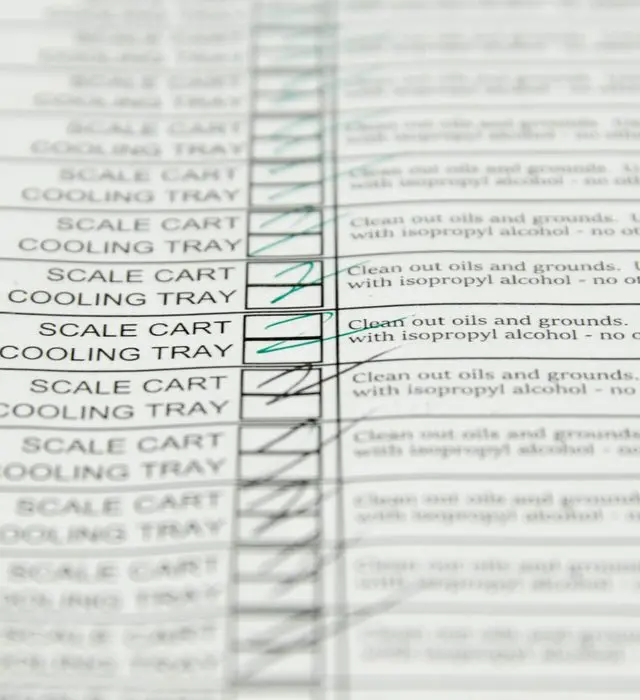
As part of the certification process, you will describe the specific management practices you use to prevent commingling and contamination in your Organic System Plan (OSP).3 Operational records are then reviewed during organic inspections to verify that these practices are consistently followed in practice, not just written in policy. For this reason, it is important to create and maintain documentation at each potential point where commingling or contamination could occur. Examples of supporting records include purge logs, cleanout and sanitation logs, bin verification forms, receiving logs, and other traceability or inventory control records that demonstrate segregation and proper handling of organic products throughout the system.4
Conclusion
While mixed-use facilities face additional complexity, preventing commingling and contamination is entirely achievable with clear systems and consistent controls. Begin by mapping both your organic and nonorganic product flows side by side and identify every point where they intersect or overlap. From there, make deliberate operational choices that mitigate and tightly control the risk of mix-ups. Work closely with your certifier throughout the process to confirm that your procedures and documentation meet organic requirements.