
What You'll Learn
- How to implement physical separation and identification in storage.
- Special considerations and requirements for off-site storage.
- Recordkeeping requirements for storage of organic products.
As with everywhere else in handling and processing, you must also prevent commingling of organic and nonorganic products during storage.1 This requirement applies even to nonorganic ingredients that are approved for use in organic production.
One effective way to support this organic control point is to adopt an “allergen mindset” in warehouse operations, treating conventional ingredients with the same level of care and segregation used for major food allergens to reduce the risk that a single nonorganic item could contaminate organic production. This caution also applies to the storage of organic finished products, where clear segregation is essential to prevent the accidental sale or distribution of a nonorganic product as organic.
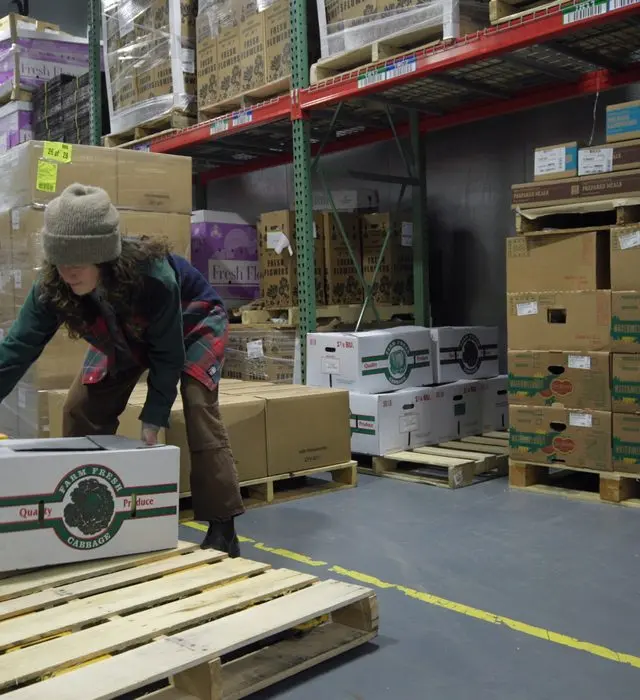
Storage practices that help prevent commingling include keeping products in sealed, clearly labeled containers, physically separating organic and nonorganic inventory into designated areas of the facility, and using clearly labeled, side-by-side pallet racking systems to maintain strict segregation. When vertical stacking is unavoidable, organic products should be stored above conventional products to reduce the risk of contamination from leaks, spills, or handling errors.
Off-Site Storage
If you store organic ingredients off-site, in most cases that location must be certified organic. If the location is uncertified, the products must be enclosed in sealed, tamper-evident packages or containers prior to arriving, and remain in that packaging while at the uncertified storage facility.2 If you store organic ingredients at an uncertified site, your certifier might ask you to complete an “exempt handler form.”
Exempt storage locations (those that are not certified to handle organic products) still need to:2
- Ensure products are not exposed to any prohibited substances;
- Keep records related to organic products for a minimum of 3 years;
- Provide documentation for traceability of the product.
Labeling and Identification Systems
It is crucial that you clearly identify organic products and ingredients in order to prevent contamination and commingling. Use distinct and consistent visual cues, including colors, a symbol, and words, where appropriate. Maximize communication by making the signs very easy and quick to understand, across English language proficiency levels. Don’t forget that packaging and any approved nonorganic ingredients used for organic processing can also be contaminated, and so should be labeled/identified.
Technology can further strengthen these controls. Barcode scanning systems and digital warehouse management tools help reduce human error by clearly directing where products should be stored, picked, and returned, ensuring that warehouse staff consistently maintain proper separation between organic and nonorganic inventory.
If it is an organic product, we’ll slap a green sticker on it … For storage purposes, we will always store organic, above nonorganic, and … we know exactly where it’s going because we can scan that barcode with that lot code into the bin number. So we can have a physical inventory, but also a digital inventory to allow us to see where things are at and where we can either slot new products or if we need to move things around.
Recordkeeping for Storage and Inventory
As with all aspects of your organic certification, there are records you must keep for products and ingredients in storage.3 The records and recordkeeping methods you choose are specific to your unique operation. These records will be reviewed when an inspector performs the annual audits on your inventory and products. Inventory management is crucial.
One type of audit your inspector will perform is called a mass-balance audit, also called an in-out audit.4 With a mass-balance audit, the inspector will verify how much ingredient or product you have on hand (from purchase and receiving records), how much was used (from production records), and what is remaining in inventory (from your storage records). You will need to account for all ingredients used in all organic products.
If you are a private label owner, your mass-balance will include ingredients sent to your copacker, if applicable, as well as finished products ordered, received, and sold. If you are a broker who does not process products, your mass-balance will cover what you purchased and what you sold, which may include physical inventory records from any off-site storage location.
Lot tracking is also important. Lot numbers must be traceable from receiving until the final product leaves your facility. A system for maintaining lot numbers for ingredients and finished products in storage is critical to maintaining organic integrity of your products. This system will be tested by your inspector through a traceback audit.4 Here, they use your records to trace back a product from when it left your facility for sale, through each step of your process, all the way back to when the ingredients arrived onsite. Lot numbers are crucial for this audit because each step must be linked by a common identifier, and lot numbers are a common and robust way to achieve this.
You will also need to keep records of sanitation and cleaning activities that occur in storage areas.3 In some settings, sanitation is minimal where cleaning substances are not likely to contact organic products. Your inspector is generally not interested in these types of sanitation activities. An example of this situation is when ingredients are stored in packages on shelves in a warehouse and the only cleaning done is to floors.
But, if any sanitation products could contact organic products in storage, you must keep records documenting when cleaning happened and how it was done in a way that prevented contamination between the cleaning product and your organic product. For example, if cheese wheels are aged prior to packaging, and the shelves on which they are stored are cleaned, cleaning products could contact the organic cheese and you must document how you prevented that.
Conclusion
Storage is often where organic integrity gets lost quietly. Not in a single dramatic moment, but through small, accumulated gaps. A mislabeled bin. A conventional pallet in the wrong place. A lot number that can’t be traced back to receiving. Get the basics right here: clear separation, consistent labeling, a lot tracking system you actually use, and you’ll find that inspection day is a lot less stressful, because the records that tell your story are already there.